 Jenni
JenniA quiet transformation begins when the body ceases to perform. A moment arrives when something deep within—the marrow—no longer bends to expectation but instead resists. The shift is subtle. It occurs when you stop adjusting, stop angling, stop offering a fabricated version of yourself. From what was once unconscious performance, something authentic begins to surface: honesty.
Lately, I’ve begun to appear in my own images. These aren’t portraits in the traditional sense, but frames suspended between gestures. I didn’t set out to photograph myself. But the work called for it, slowly—frame by frame. It asked not for beauty, but for truth.
The images arrived before language—whole, quiet, certain, already aware.
It is strange and unfamiliar. I watch myself emerge like an image in a darkroom—gradually revealing a figure once obscured. A shape takes form—hovering between the known and unknown, the material and immaterial. This figure—she—has always existed just beyond what I was taught to keep concealed.
No intention to perform. No plan to be seen.
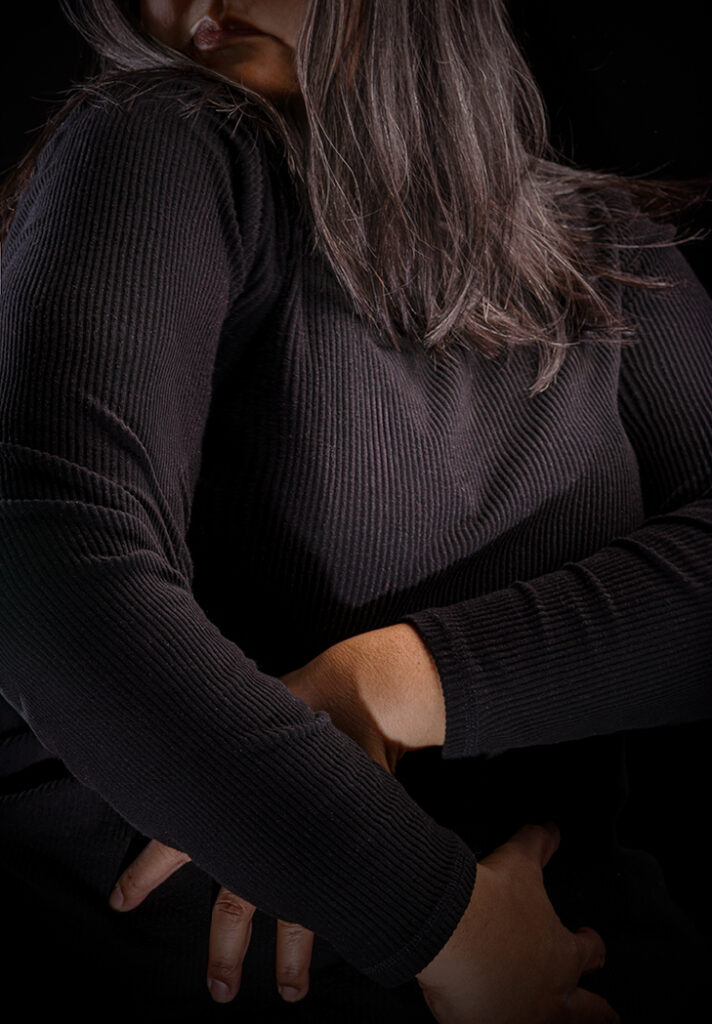
The body—my body—which once complied with the imperative to please or disappear, simply no longer desires to perform. Not out of defiance, but as a quiet, irrevocable shift in being. This transformation—though invisible, seemingly quiet—is seismic.
The posture that once appeased the traditional gaze begins to unravel. I move as my body moves. I do not wither. I do not collapse. Those who are watching may—but I remain.
In these images, it is not the pose that speaks, but something subtler. A hand curled inward—not offered or arranged, but folded by instinct. A gesture shaped by need, not grace. The body curves—not in collapse, but in yielding. No perfected angle. No practiced gesture. Only the unguarded truth of a body meeting itself in stillness.
It asks for neither beauty nor boldness. It simply is: unresolved, unedited, held in quiet, protected vulnerability. And from that space, something I’ve long avoided emerges: authorship lives not in control, but in the willingness to allow. To let meaning arrive on its own terms—and remain long enough for it to open something more profound.
This visibility is not merely an aesthetic decision; it is a reckoning. The discomfort it evokes is not outside the work—it is central to it.
Now, the lens turns inward—not to flatter, but to witness. Not to curate, but to remain. And in that act of remaining, something steadies. It seeks no applause. It asks for neither forgiveness nor admiration. It resists both spectacle and erasure. It stays—unflinching, unadorned. Not to prove anything, but because presence, in and of itself, is enough.
This way of seeing—this unflinching presence—is political. Especially for someone like me: racialized, inhabiting a body shaped by colonial ideals yet refusing their hold. A soft-bodied, liminal figure—never quite aligning with the beauty standards constructed without me in mind. Presence becomes resistance. Visibility, when no longer shaped for someone else’s consumption, becomes a quiet protest. Especially when the gaze I answer to is my own.
There is power in letting an image live. Letting it breathe without justification. Letting it ask something of me—and choosing not to look away.
If this feels unfamiliar to you, know that it does to me too. But I’m staying with it—and letting it stay with me.
I return to each photo once more: the pause of a body mid-motion—not posed, not poised, but suspended in breath. A murmur between gestures. A form no longer performing, no longer asking—simply present, simply human.